
Happy Hour: Churchill’s D-Day
March 25 @ 4:00 pm – 5:00 pm UTC+0
Sponsored by ESU Central PA Branch
Operation Overlord was the code name for the Allied invasion of Nazi-occupied Western Europe during World War II, launched on June 6, 1944 (D-Day). It was the largest amphibious invasion in history, involving 160,000 troops landing across five Normandy beaches. Winston Churchill, while cautiously supportive, initially held reservations about potential heavy losses but ultimately ensured its success as a key strategic architect.
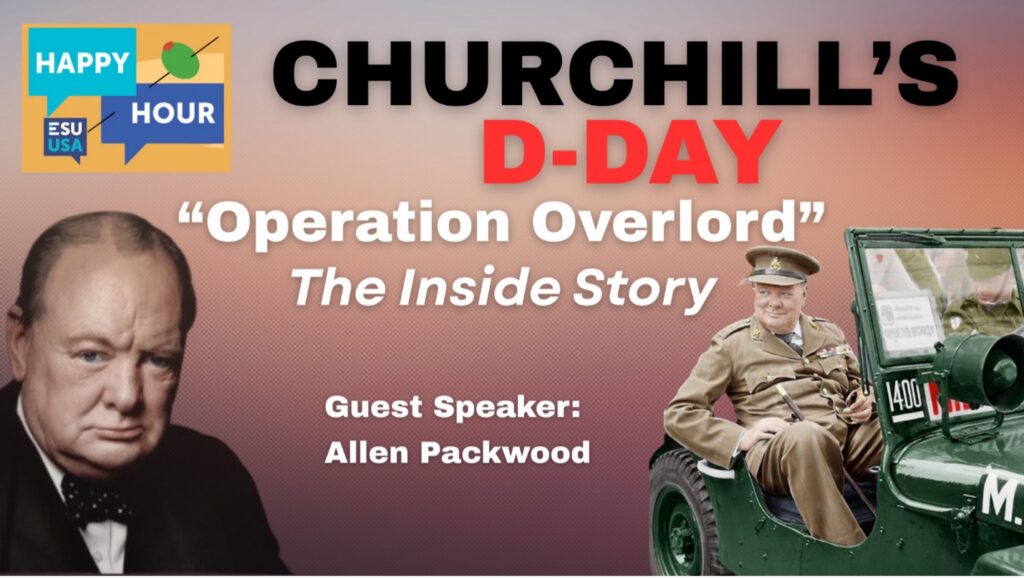
Allen Packwood, Director of the Churchill Archives Centre, will explore Churchill’s often neglected role in the planning and execution of Operation Overlord. He will use key documents from Churchill’s papers to tell the inside story.
ESU members and guests are invited to this Happy Hour which gives an in-depth look at this pivotal moment in history as allied forces opened a “Second Front” in Europe, ultimately liberating France.
This ESU Happy Hour is sponsored by the Central Pennsylvania Branch. ESU Happy Hour programs are online, free to attend, and open to all members and the public. Registration is required to receive the webinar link.
About Allen Packwood OBE

As Director of the Churchill Archives Centre at Churchill College at the University of Cambridge since 2002, Allen has dedicated his career to preserving and illuminating history. A qualified archivist and Fellow of the Royal Historical Society, he oversees one of the world’s most significant collections of modern political, diplomatic, and scientific papers, including those of Sir Winston Churchill and Baroness Thatcher.
His expertise has taken him from curating exhibitions at the Library of Congress to organizing international conferences on the Cold War, and from Bermuda to Hong Kong, sharing Churchill’s life story and legacy.
Packwood has a BA, and MPhil (Cantab) and is a Fellow of Churchill College at the University of Cambridge. He was awarded an OBE for services to archives and scholarship in the 2016 Queen’s Birthday Honours. His latest book, Churchill’s D-Day, The Inside Story co-authored with General Lord Dannatt, was published for the eightieth anniversary of Operation Overlord in June 2024.
As Director of the Churchill Archives Centre at Churchill College at the University of Cambridge since 2002, Allen has dedicated his career to preserving and illuminating history. A qualified archivist and Fellow of the Royal Historical Society, he oversees one of the world’s most significant collections of modern political, diplomatic, and scientific papers, including those of Sir Winston Churchill and Baroness Thatcher.
His expertise has taken him from curating exhibitions at the Library of Congress to organizing international conferences on the Cold War, and from Bermuda to Hong Kong, sharing Churchill’s life story and legacy.
Packwood has a BA, and MPhil (Cantab) and is a Fellow of Churchill College at the University of Cambridge. He was awarded an OBE for services to archives and scholarship in the 2016 Queen’s Birthday Honours. His latest book, Churchill’s D-Day, The Inside Story co-authored with General Lord Dannatt, was published for the eightieth anniversary of Operation Overlord in June 2024.
Cocktail: Manhattan
Ingredients:
Whiskey, 2 oz Rye or Bourbon
Sweet Vermouth: 1 oz
Angostura Bitters: 2 dashes
Garnish: Maraschino cherry or lemon twist
Instructions:
Combine the whiskey, sweet vermouth, and bitters in a mixing glass filled with ice.
Stir until well-chilled.
Strain into a chilled coupe or cocktail glass.
Garnish with a brandied cherry or a lemon twist.
Like so many cocktails, their origins and history are lost to the vagaries of time, leading to intriguing theories, one including the mother of Prime Minister Winston Churchill as its possible inventor.
A widely shared story suggests that the cocktail dates to the 1870s, and despite being named after the New York City borough, there’s a connection to the United Kingdom. This story has it that one Dr. Iain Marshall came up with the classic Manhattan recipe while attending a party that was held at the Manhattan Club for Lady Randolph Churchill, the mother-to-be of the not-yet-born Winston Churchill.
Of course, as most legends do, this story has been called into question because there are indications that Churchill’s mother was in either France or England at this time. Some dispute this and believe that a bartender going by the name of ‘Black’ invented the cocktail at the famed Hoffman House in New York City.